 Oahu Whale Watching Tours
Is Whale Watching in Oahu Worth It? An Honest Look
Is whale watching in Oahu worth it? Yes, if you go between January and March and accept that a boat will hold 100 yards back by federal law; no, if you need a guaranteed close breach or can't stomach a re-ride instead of a refund on a no-whale trip. The four Oahu whale watching cruises compared here run $53 to $119 per adult, and what changes at each price point is comfort and crowd size, not the whales themselves. This guide walks the real cost, what a trip actually delivers, and the honest downsides nobody puts in the listing description.
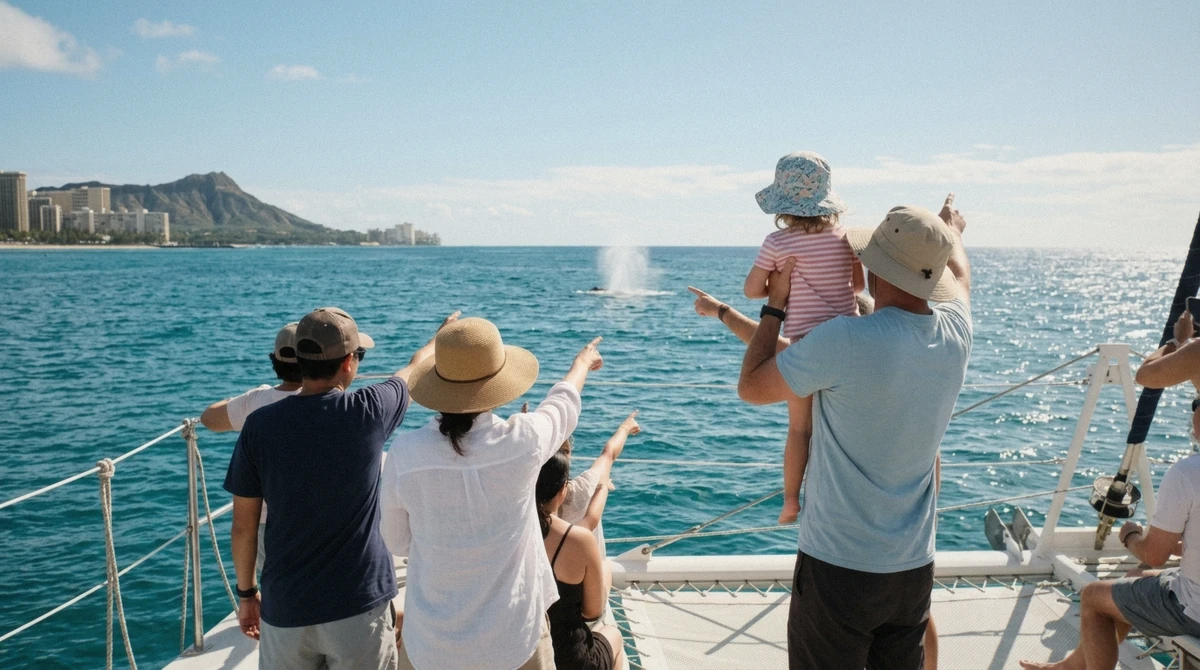
A working whale watching sail off Oahu, mid-trip rather than a marketing pose.
Quick answer
Whale watching in Oahu is worth it if you travel between January and March, don't need a guaranteed breach, and are comfortable with distance viewing under the federal 100-yard rule. It costs $53 to $119 per adult depending on the boat, and what you reliably get is a blow, a fluke, and often a mother with a calf, from a stable, sober crew who know where to look.
Key takeaways
- Price range: $53 to $119 per adult across the four cruises compared here, plus a free shore-watching alternative
- Best reason to go: up to 10,000 humpbacks winter in Hawaii after a roughly 3,000-mile swim from Alaska, and January through March is close to a sure thing
- Biggest honest downside: every operator's guarantee is a free re-ride, not a refund, if no whales show
- Skip it if: you get seasick easily on the choppier south-shore boats, or you're chasing a close-up breach rather than a distant blow
- Best timing: January through March, morning departures for the calmest water
- Book through the comparison here rather than a hotel desk and the same seat can run noticeably cheaper
The Short Answer
A conditional yes
Whale watching in Oahu earns its price for most travelers who go in the right months and know what they're paying for: proximity rules, a trained crew, and the odds that come with a boat actively searching, rather than a fixed shore view. It is not worth it for someone expecting a close, guaranteed, National-Geographic-style encounter, because federal law and simple biology both work against that expectation.
- Worth it if you're traveling January through March, when sightings are close to routine
- Worth it if you're already in Waikiki and don't want to fly to Maui or pay its higher prices
- Worth it if a blow, a fluke and a distant breach count as a real wildlife encounter for you, not just a close-up
- Skip it if you or a travel companion get seasick easily and can't take the choppier boats
- Skip it if your one goal is a close breach; the 100-yard rule caps how near any boat can get
- Skip it if you're traveling outside December through April, when the season is effectively closed
What It Actually Costs
Four tiers, one free option
The table below reflects list prices as of August 2026. Duration and inclusions vary more than the price does, and that gap is where the real decision sits.
| Option | Typical price | Duration | Best for |
|---|---|---|---|
| Pink Sails Waikiki catamaran | from $53 | 2 hours | Budget travelers, biggest review base |
| Living Ocean sunset cruise | from $54 | 1.5–2 hours | Best-rated, photographers who want sunset light |
| Hawaii Nautical West Oahu sail | from $89 | 2 hours | Calmer water, motion-sickness-prone travelers |
| Hawaii Nautical Waikiki Deluxe | from $119 | 2 hours (some reviewers clock under 90 minutes) | Hotel pickup, premium bar, small-group option |
| Shore lookout | $0 | Open-ended | Budget-zero travelers, a backup if boats sell out |
What actually drives the spread
The gap between $53 and $119 buys a fuller bar, hotel pickup, and a calmer route on the leeward side, not a better chance of seeing a whale. Every dollar above the base fare is paying for comfort and convenience, which is a legitimate reason to spend more, just not the reason most people assume when they see the higher number.
What You Get for the Money
The shape of a typical trip
Boats leave from Kewalo Basin or Waianae Small Boat Harbor, run out along the coast, and then idle in an area where whales have been active that week while the crew scans the water. Once a whale is spotted, the captain holds position and lets the animal set the distance, since federal rule caps how close any vessel may legally approach a humpback at 100 yards. Most trips run close to two hours door to door, though the most expensive listing in this catalog has drawn repeated reviewer reports of finishing under 90 minutes.
What you'll typically see
A blow, visible from close to a mile away on a clear day, is the most common first sign. From there, a fluke-up dive, a tail slap or a pectoral slap are all realistic outcomes; a full breach happens too, though crews put the odds around 5% of encounters, a working estimate from the deck rather than a published statistic. February and March add mothers traveling with newborn calves, among the more memorable sightings reported across all four boats.
None of this is guaranteed, and no listing promises otherwise.
What's included versus what isn't
All four boats include the naturalist narration and the search itself in the base price; drinks and snacks vary by operator, and hotel pickup is a paid add-on on exactly one of the four. Independent travelers with a rental car can watch for free from shore, especially around Makapuu or Diamond Head, and still get a real sighting on a clear winter morning.
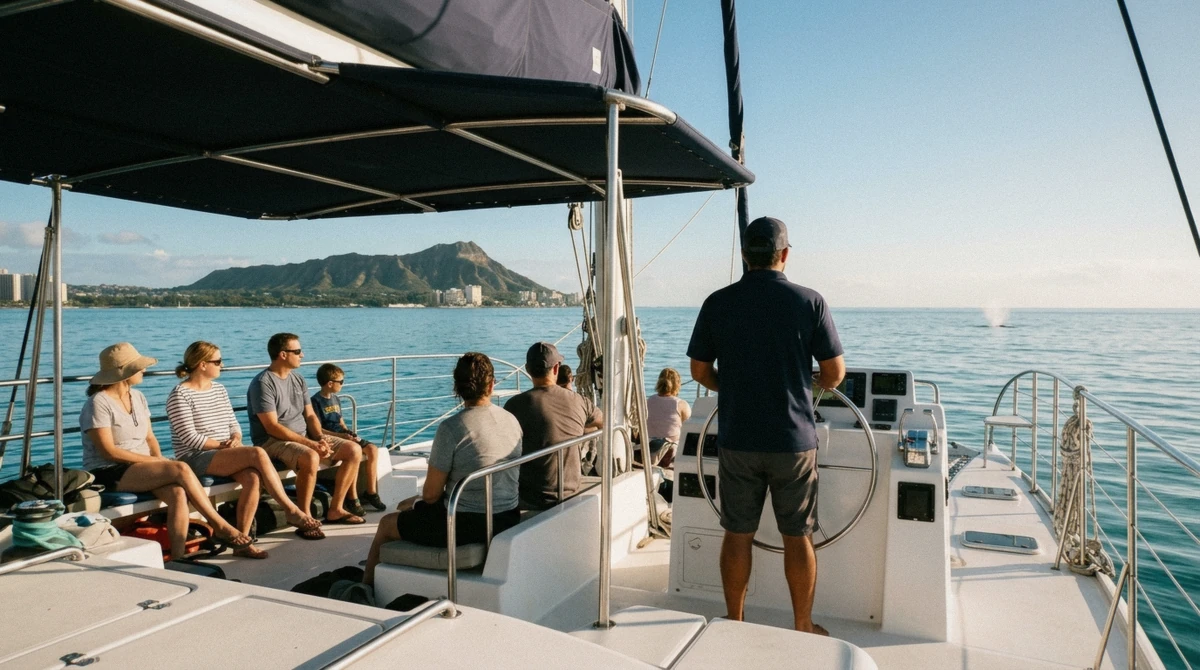
A blow at distance, the most common sighting on an Oahu whale watching trip.
The Honest Downsides
The guarantee is a re-ride, never a refund
Every one of the four listings frames its whale guarantee the same way: if you see no whales, you get a free repeat trip, not your money back. Hawaii Nautical prints it outright as "re-ride only, no refunds." That voucher is only useful if you have another day left on the island to use it, which makes it a poor fit for a tight one-day layover.
Afternoon water gets genuinely choppy
Trade winds build through the day off the south shore, and several reviewers of the morning-and-afternoon boats mention motion sickness on windier days. The leeward Waianae route sits more sheltered and rides flatter, but the two Kewalo Basin boats can get a real bounce by early afternoon.
Under-90-minute trips on the priciest listing
The $119 Waikiki Deluxe catamaran draws the most repeated complaint about duration in this catalog: multiple reviewers report the trip wrapping in under 90 minutes despite the listed two-hour runtime. That's a real gap between the price and the time actually spent on the water.
Distance viewing is the rule, not the exception
The 100-yard federal approach limit means the default view is a blow or a fluke well off the bow, not a close pass. Some of the closer encounters described in reviews happen because a whale approaches the boat, a legal "mugging," but that's the whale's choice, never something a captain can engineer.
When It's Worth It Most
January through March, mornings
The season's peak overlaps with the calmest water: trade winds build through the day, so an 8:00 AM departure rides flatter than an afternoon slot, and January through March is when every operator's own season window overlaps. That combination, peak months plus a morning sailing, is when the price is most clearly earned. The full month-by-month breakdown, including why the four operators publish different season dates, is on Oahu whale watching season.
Who Should Do It, and Who Should Skip It
If You're traveling January through March and want a straightforward, reasonably priced outing
Go. This is the window every operator agrees on, and the $53 Pink Sails catamaran covers it at the lowest price in the catalog.
If You or someone in your group gets seasick easily
Book the West Oahu sail from Waianae; the leeward coast rides noticeably calmer than the Waikiki-side boats.
If You're bringing young children
Age rules differ by boat, from infants-on-laps to a strict under-3 exclusion. The full breakdown is on whale watching with kids in Oahu.
If You want a close, guaranteed breach shot
Skip it, or adjust expectations. The 100-yard federal rule and roughly 5% breach odds per encounter mean distance viewing is the norm, not a close-up.
If You're a budget traveler with a rental car and flexible timing
Try a free shore lookout first (covered on the homepage's shore-watching section) before paying for a boat.
How to Book Without Overpaying
Book a week or two ahead in peak season
January through March fills fastest on weekends, so a booking made a week or two out gets first choice of departure time; free cancellation up to 24 hours on all four listings means there's little downside to locking in early and adjusting later if plans change.
The same seat can cost noticeably more at a hotel desk
Reviewer reports describe the identical Hawaii Nautical sail costing $89 through an online platform against $99.95 booked directly on the operator's own site, and one traveler reported paying roughly $40 more for the same trip at a hotel activity desk than the online price. The lesson holds across the catalog: compare the online listing before adding a tour desk to the itinerary.
Three picks by traveler type
For the lowest entry price, the Pink Sails catamaran at $53 also carries the catalog's largest review base. For the best rating and a sunset backdrop, the Living Ocean cruise tops out at 4.8. For calmer water and a fuller bar, the Waianae sail is the pick, and it's also the better choice for anyone prone to seasickness.
Compare all four before booking
Every tour on this page links back to Oahu whale watching tour prices and comparisons and the full breakdown of what each boat includes at its price point.
The honest verdict: worth it in peak season, worth skipping if a close guaranteed breach is the only acceptable outcome. Everything in between comes down to matching the boat to your budget, your stomach for chop, and how many days you have left on the island if the guarantee gets used.
What is the best month to see whales in Oahu?
January through March, when sightings are close to routine across all four boats. The full month-by-month reasoning is on Oahu whale watching season.
Is Maui or Oahu better for whale watching?
Maui's Au'au Channel holds a denser concentration of whales, but Oahu is cheaper to reach if you're already staying there and skips an inter-island flight. The full comparison sits on Oahu vs Maui whale watching.
How much does it cost to whale watch in Hawaii?
On Oahu specifically, the four cruises compared here run $53 to $119 per adult, plus a free shore-watching option. Maui's typical entry price runs higher, closer to $75 and up.
What time of day are you most likely to see whales in Hawaii?
Whales show no real preference for time of day; morning departures just ride calmer water as trade winds build through the afternoon. See best time of day, expanded for the full breakdown.
Do I get a refund if the boat sees no whales?
No. Every operator in this catalog offers a free re-ride, not cash back, and Hawaii Nautical states that plainly on its own listing. The voucher only helps if you have another day left on the island.
How close will the boat actually get to a whale?
No closer than 100 yards under federal sanctuary rules. Whales sometimes close the distance themselves, a legal encounter reviewers call a "mugging," but no captain can engineer that.
Is it worth paying more for the premium boats?
It buys a fuller bar, hotel pickup, and a calmer leeward route, not better whale odds. The $89 Waianae sail is the strongest case for spending above the $53 base fare, mainly for motion-sickness-prone travelers.