 Oahu Whale Watching Tours
How to Photograph Whales from a Boat: Oahu Field Guide
How to photograph whales from a boat comes down to one federal fact: every vessel holds at least 100 yards off the animal, so the winning frame is whale plus landmark, not a cropped close-up. That single fact changes what to pack, where to stand, and which shot is realistic on the Oahu whale boats compared here. This guide reads the deck layouts, camera advice in reviewer photos, and timing patterns across the four cruises in the catalog, so a camera or a phone is set up for the shot that's actually available rather than the one a zoom lens promises from shore.
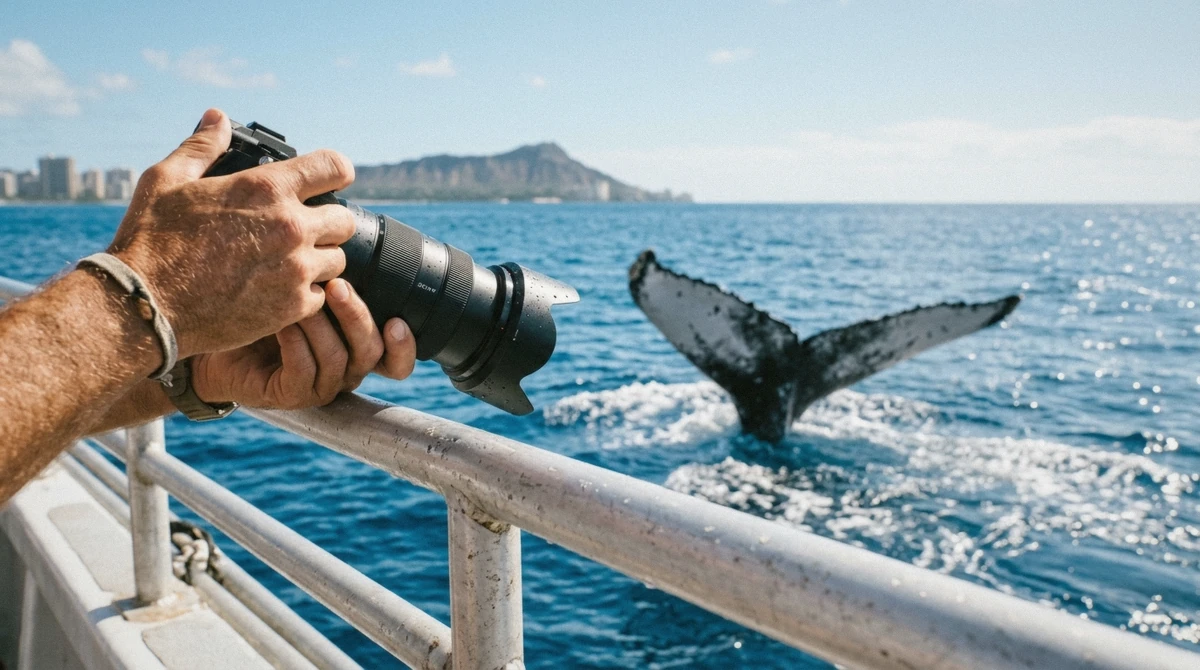
Diamond Head in frame turns a distant blow into a shot with a sense of place.
Quick answer
The best whale photos from an Oahu boat come from framing the animal against Diamond Head or the Waikiki skyline rather than trying to fill the frame, since the federal 100-yard rule keeps every vessel that far back. A fast shutter, burst mode, and a wrist strap cover most of what goes wrong on deck.
Key takeaways
- Vessels hold a 100-yard distance by law, so compose whale-plus-landmark rather than chasing a tight close-up
- A raised fluke usually signals a deep dive and is often the last shot before the animal disappears for several minutes
- Crew on Pink Sails estimate a breach happens in roughly 5% of encounters, so plan around blows and tails, not the leap
- Morning departures on Waikiki Deluxe give the calmest deck for a steady shot; the sunset cruise trades stability for backlit skyline light
- Several reviewers describe losing a shot fumbling a wet phone; a wrist strap costs nothing and spray hits the bow first
- Land-based photography with a longer lens is covered separately for the North Shore lookouts
The Oahu Frame
What separates an Oahu whale photo from an open-ocean shot is the skyline behind it.
Diamond Head and the Waikiki skyline do the work
South-shore departures run past Diamond Head, and reviewers across all four listings mention the crater as a backdrop as often as they mention the whales themselves. A blow or a fluke shot against that ridge line reads as an Oahu photo instantly, which a whale alone against open water does not. The same logic applies to hotel towers along Waikiki on the sunset run: include them deliberately rather than crop them out.
- South-shore route: Diamond Head crater as a fixed reference point for composition
- Sunset route: Waikiki hotel towers and the horizon line double as a warm-light backdrop
- West-side route from Waianae: the Waianae mountain range instead of a city skyline
Winter light changes the color, not just the angle
Whale season runs through the winter months, when the sun sits lower and the light stays warmer for longer through the morning and again before sunset. That lower angle means fewer harsh overhead shadows on the water and a better chance the ocean itself picks up color rather than reading as flat gray-blue, which is the single biggest difference between a forgettable whale photo and one worth keeping.
Editing honesty, before the trip
The images on this page are lightly processed, not heavily saturated postcard renders, and it is worth setting that expectation before booking a cruise. Open water on a clear December morning reads as a deep, genuine blue without any editing at all, but on an overcast day the same water can look flat gray in a straight-out-of-camera shot. A light lift in contrast and a small saturation bump in post-processing brings a gray-day photo closer to what the scene actually felt like standing on deck, and that is a reasonable edit rather than a misleading one.
Where to Stand
Deck position decides more about a photo than any camera setting.
Upper deck, back rail, or bow, each trades something
The table below compares the three positions available across the catalog's boats and what each one actually trades off.
| Position | Best position | Why |
|---|---|---|
| Pink Sails Waikiki | Upper deck, either side | Height clears the rail line in frame and keeps you dry; catamaran design puts the upper deck well above spray |
| Sunset Whale Watch | Back deck, port side at sunset | Double-decker layout puts the back rail furthest from engine vibration, and port side faces the sun on the return leg |
| West Oahu Sail | Bow, on calm days only | Waianae's leeward water is the calmest crossing in the catalog, so the bow is usable there when it would be soaked elsewhere |
| Waikiki Deluxe | Upper deck, forward of the bar | Morning 8 AM departure means the calmest deck of the day; forward position keeps sightseers and the bar line out of frame |
The bow is a gamble everywhere else
On any boat running the open south-shore water rather than Waianae's sheltered leeward coast, the bow catches spray first and often gets wet within the first twenty minutes. It is the best angle for an unobstructed shot when conditions allow it and the worst place to be holding an uncovered camera when they do not. Ask crew before claiming a bow spot; on rougher mornings they will usually say so.
Camera Settings That Work Here
The settings that matter come down to speed, not resolution.
Shutter speed and burst mode over anything else
A whale surfacing and diving again takes seconds, and a moving boat adds its own shake on top of that. A shutter speed of 1/1000s or faster, paired with continuous burst mode, catches the moment a fluke lifts or a blow fires rather than the half-second after it. Flash does nothing useful at boat-to-whale distance and only draws attention on deck; leave it off.
- Shutter speed 1/1000s or faster
- Continuous burst / drive mode, not single shot
- Flash off
- Lens or phone case wiped dry before each approach
- Wrist strap on, every time a camera comes out on deck
- Spare battery or charged phone if shooting a full 2-hour cruise
Phone versus a zoom lens
At the legal 100-yard distance, a phone's default lens renders a whale as a small dark shape unless a landmark composition carries the frame, which is exactly the approach this guide recommends. A 200-400mm zoom brings the animal closer in frame without breaking the distance rule, and it is the more forgiving tool for anyone set on a tighter shot. Either way, digital zoom on a phone past 2x mostly loses detail rather than gaining it; crop after the fact instead.
Spray protection is not optional
A splash guard or even a sandwich bag over a phone costs nothing and prevents the single most common camera failure reported in reviews across the catalog: a soaked lens or a dropped phone reaching for a shot too late. Keep gear in a dry bag between sightings and only out when a whale is actually visible.
A tripod is the wrong tool on a moving deck
A boat pitching on open water defeats the point of a tripod almost immediately; the mount transmits every roll of the hull straight into the shot instead of steadying it. Image stabilization built into a modern camera or phone, combined with the fast shutter speed above, does more good on deck than any tripod could. Save the tripod for a shore-based shoot at one of the North Shore lookouts, where it is a genuinely useful tool on stable ground.
The 100-Yard Reality
Distance is a legal fact of Oahu whale photography, not a limitation to fight.
Compose for distance instead of fighting it
Federal rule keeps every vessel at least 100 yards from a humpback whale in Hawaiian waters, and no operator in the catalog gets an exception. That means a full-frame close-up the way a wildlife documentary shows it is not something a boat photo will ever produce here. The better shot, and the one that actually reads well later, pairs the whale with the water, the light, and the Oahu skyline around it rather than cropping in tight on a small, distant shape.
Blows carry further than the whale itself
On a clear day, a blow is visible roughly a mile out, well before the whale's back or fin is distinguishable. That makes the blow the earliest and often the most reliable subject: a tall white column against blue water reads clearly even at range, and it usually signals where to point a camera for the surface moment that follows a few seconds later.
Timing the Behaviors
Whale behavior on Oahu follows a rough, repeatable sequence worth shooting for.
Blow, count, fluke
A typical surface sequence starts with a blow, followed by two or three more blows as the whale breathes at the surface, and closes with a raised fluke as it dives deep again. That fluke-up moment is often the last shot available before a whale disappears for several minutes, so it is worth treating as the priority frame in a sequence rather than the opening blow.
Breach odds are real but rare
A crew member on Pink Sails puts breach odds at roughly 5% of encounters, a working estimate from experience rather than a published study, but it lines up with how rarely reviewers across the catalog mention catching one on camera. Plan a cruise around blows, tail slaps, and fluke dives as the realistic targets, and treat any breach as a bonus rather than the shot the trip depends on.
Mothers and calves peak in February and March
Mother-and-calf pairs are most visible on Oahu waters in February and March, and calves surface more often and more predictably than adults traveling alone, which can make them an easier subject during those months. The full whale watching season on Oahu compared across all four operators covers timing in more depth for anyone planning a trip around this window specifically.
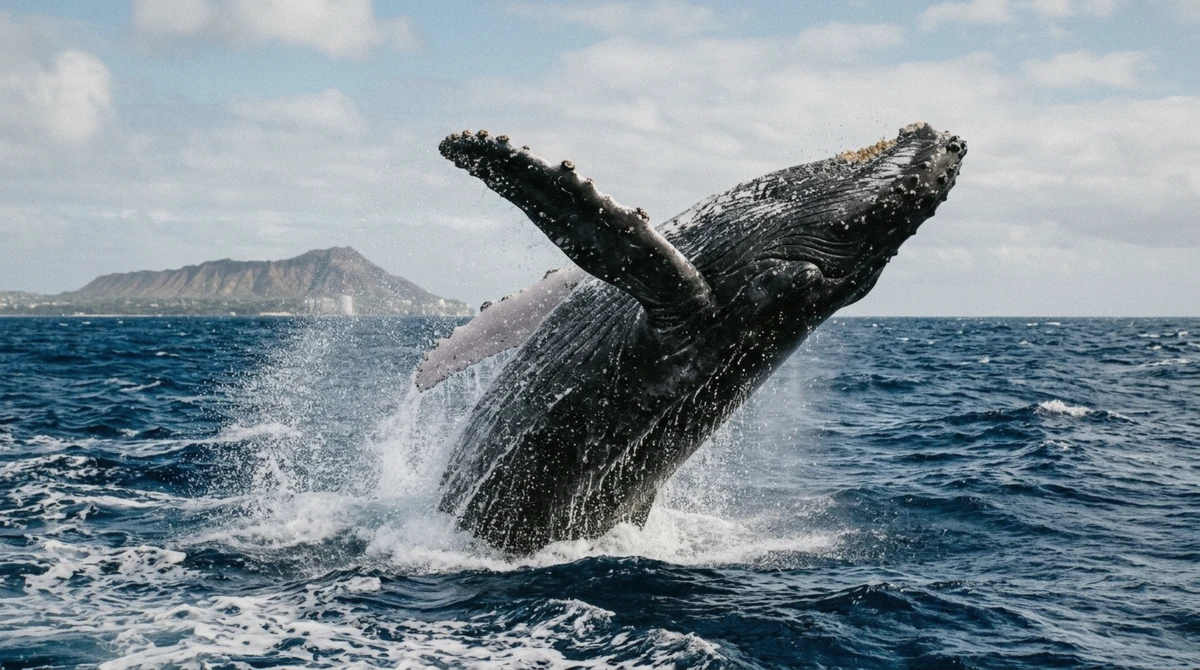
A breach lasts about two seconds; a pre-set fast shutter and burst mode are what catch it.
Sunset-Specific Advice
The one sunset departure in the catalog asks for a different exposure strategy than a morning cruise.
Backlit blows on the sunset cruise
On the sunset whale watch from Kewalo Basin, a blow against a setting sun often turns into a silhouette or a backlit spray rather than a lit, detailed column of water. That's a different shot than a morning cruise produces, not a worse one: it trades detail for color and mood, and it's the one time in the catalog when shooting directly into the light is worth doing on purpose.
Expose for the highlights, not the whale
When shooting into a setting sun, a camera or phone metering on the whale itself will usually overexpose the sky and lose the color that made the shot worth taking. Locking exposure on the brightest part of the sky, or dialing exposure compensation down a stop or two, keeps the sunset color intact even if the whale itself renders darker or as a silhouette. That trade is usually the right one for this specific light.
Etiquette and Drones
A short set of rules protects the animals and, in practice, protects the shot too.
No drones near wildlife
None of the four boats in the catalog permit drone use near whales, and flying one close to a marine mammal in Hawaiian waters risks violating the same distance protections that keep vessels 100 yards back. Leave a drone packed for this specific trip; it is not a workaround for the distance rule, and crew will ask you to stop.
No flash, and keep gear low-key on deck
Flash photography does nothing useful at open-water distance and mainly disturbs other passengers trying to watch the same sighting. Keep camera gear compact and out of the aisle between sightings; deck space fills up fast the moment a blow is spotted, and a tripod or a large case underfoot is the fastest way to miss the shot entirely.
Personal photos need no permit; a paid shoot is a different question
None of the four operators in the catalog require any paperwork for a passenger shooting personal photos on board, camera or phone, no exceptions noted. A commercial or paid photography session on a chartered whale watching cruise is a separate arrangement entirely and would need to be worked out directly with the operator in advance; nothing in the four listings describes a standing policy for that use, so ask before assuming it is covered.
Which Tour for Photographers
Deck stability, light, and timing point toward different boats for different priorities.
Sunset for light, morning for calm decks
The sunset cruise is the pick for anyone prioritizing color and a skyline backdrop, at the cost of a boat that's moving into lower light with less time before dark. Waikiki Deluxe's 8 AM departure is the calmest deck in the catalog by timing alone, which matters more than any camera setting when the water itself is moving less.
For the tightest budget shot
Pink Sails is the cheapest listing at $53 and its upper deck sits well clear of spray, making it a reasonable pick for a first attempt at boat photography without paying for the premium decks on the other three cruises. A steadier, calmer crossing on the West Oahu sail from Waianae makes its bow position usable on days when every other boat's bow is too wet to shoot from.
None of this replaces a longer lens or a faster shutter speed. It replaces the expectation that a boat photo should look like a close-up. Compose for the landmark, time the fluke, and the distance stops being a limitation and starts being the frame.
What distance should you stay away from a whale on a boat?
Federal rule requires vessels to hold at least 100 yards from a humpback whale in Hawaiian waters. Every boat in the Oahu catalog follows this distance, which is why a landmark composition works better than trying to fill the frame.
What is the most difficult animal to photograph on a whale watching tour?
A breaching whale is the hardest shot in the catalog by far. Crew on Pink Sails estimate it happens in roughly 5% of encounters, so most usable photos come from blows, tail slaps, and fluke dives instead, which surface far more predictably.
What type of camera is best for taking whale photos?
A camera with a fast burst mode and a 200-400mm zoom gives the most flexibility at the required 100-yard distance, but a modern phone with a wrist strap and a fast shutter setting covers most sightings well, especially when composed against Diamond Head or the skyline rather than cropped tight.
What are some tips for taking good photos of whales while whale watching?
Shoot at 1/1000s or faster with burst mode on, keep flash off, and compose the whale against a landmark like Diamond Head instead of trying to fill the frame. A wrist strap and a dry bag between sightings prevent the most common failure: a dropped or soaked phone.
Can you use a drone to photograph whales near Oahu?
No. None of the four operators in the catalog permit drone use near wildlife, and flying close to a whale risks the same distance protections that apply to vessels.
Is the morning or sunset cruise better for photos?
It depends on the shot. Morning departures on Waikiki Deluxe give the calmest deck for a steady, detailed shot, while the sunset cruise trades stability for backlit color and a warm skyline.
Do I need a zoom lens if I only have a phone?
Not strictly. A phone works within the 100-yard rule if the shot is composed around a landmark rather than a tight crop on the whale. A zoom lens helps fill the frame more, but it is not required for a usable photo from any of the four boats.